
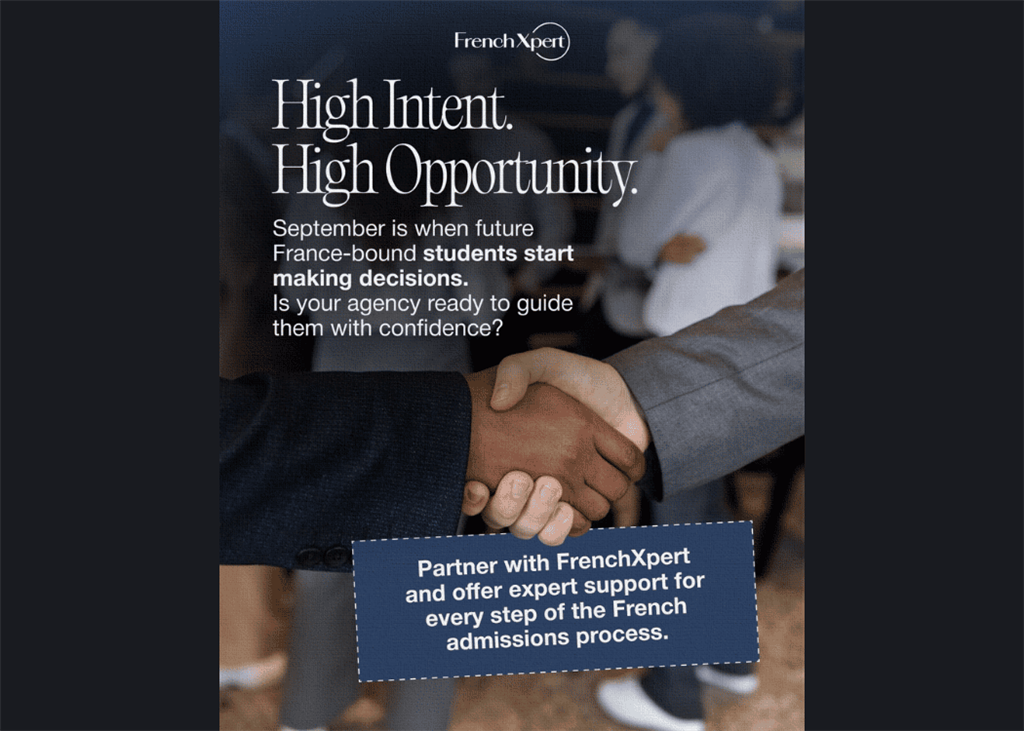
September has a particular energy in France. Universities reopen, students return to campus, families begin making serious decisions about the academic year ahead and conversations about future study plans suddenly become much more concrete. For international education agents, this period matters because interest in studying in France tends to shift from general curiosity to genuine intent. Prospective students are no longer simply asking what France has to offer. They are starting to ask how applications work, which programmes suit their background, what funding is available and what they need to do next.
That creates a valuable opportunity for agencies, but only if they are ready to respond with confidence and precision.
France can be an extremely attractive destination for international students, with respected universities and grandes écoles, a broad selection of postgraduate programmes, internationally recognised qualifications and a strong academic and cultural reputation. At the same time, the application journey can feel complex to students who are unfamiliar with the French system. Questions around Master 1 and Master 2, Campus France procedures, CROUS accommodation, scholarships and admissions requirements can arise from the very first enquiry.
When those questions are answered clearly and quickly, an agency can build trust almost immediately. When responses are vague, slow or overly generic, a motivated student may simply continue their search elsewhere.
The rentrée is much more than the return to classrooms after the summer. It marks the reopening of academic life across France and often acts as a psychological starting point for students planning their next move.
A student who spent the summer casually researching overseas study may begin September with much more specific questions. Which universities should they target? Can they enter directly into a Master 2? Do they need to apply through Campus France? Are there scholarships for international students? How early should they start looking for accommodation? What documents will they need?
These are high value enquiries because they often come from students who have already progressed beyond the inspiration stage. They are beginning to assess feasibility, timelines and application requirements.
For agencies recruiting students to France, this means September should be treated as an important conversion period rather than simply another month in the recruitment calendar.
One of the first areas agents need to explain confidently is the structure of postgraduate study in France.
The French Master degree is generally divided into two academic years. Master 1 represents the first year of the programme, while Master 2 is the second. Although this structure may appear straightforward, international applicants frequently need guidance about entry points, academic equivalencies and whether their existing qualifications allow them to apply directly to a particular level.
Students may also encounter different application procedures depending on the institution, programme and their country of residence. Some may be eligible to apply directly to a university, while others may need to follow specific procedures connected to Campus France.
An agent who understands these distinctions can help students avoid inappropriate applications and unrealistic expectations from the beginning. Just as importantly, that knowledge creates confidence. A student is far more likely to continue working with an adviser who can explain the system clearly than with someone who needs to research every question after the conversation has ended.
Campus France plays an important role in the French international education landscape and can be one of the most confusing parts of the process for prospective students.
Depending on a student's nationality, country of residence and chosen institution, Campus France may be involved in the application or pre visa process. Students often want to know whether they need a Campus France account, what documentation is required, whether an interview is involved and how Campus France fits alongside their university application.
These are not questions that students necessarily leave until the final stages of enrolment. They frequently appear during the first conversation with an agent.
Being able to explain the process accurately at that point can make a significant difference. It allows the agent to set expectations, outline realistic timelines and demonstrate specialist knowledge of France as a study destination.
Academic programmes may attract the initial enquiry, but accommodation can strongly influence whether a student eventually feels comfortable proceeding with an application.
CROUS is therefore another term that agencies recruiting for France should be prepared to discuss. The regional CROUS network provides a range of student services, including access to certain student residences and support connected to university life.
International students may assume that university accommodation in France operates in the same way as it does in other study destinations, only to discover that availability, application processes and eligibility can vary.
Agents do not need to promise accommodation solutions that are outside their control, but they should be able to explain what CROUS is, where it fits within the wider accommodation landscape and why students should begin researching their options early.
This kind of practical guidance can be particularly reassuring for parents, who may be assessing not only the academic quality of a programme but also how smoothly their son or daughter will be able to settle into daily life in France.
Cost remains one of the most important considerations in international education, which means scholarship questions can quickly become central to the recruitment conversation.
France offers a variety of funding opportunities, but eligibility differs considerably. Scholarships may be linked to government programmes, institutions, academic level, nationality, subject area or specific bilateral initiatives.
The challenge for an agency is not simply knowing that scholarships exist. It is understanding how to guide a student towards realistic possibilities while avoiding promises that cannot be guaranteed.
Students who believe France is financially out of reach may abandon the destination before investigating their options properly. An informed adviser can help them understand tuition costs, possible scholarship routes, living expenses and the wider financial picture before they make that decision.
Knowledge is only part of the conversion equation. Timing matters too.
High intent leads are rarely speaking to only one agency or researching only one destination. A prospective student considering France may simultaneously be exploring Germany, the Netherlands, Spain, Ireland or another European option. They may also be speaking with several advisers.
A response that arrives days later with general information may therefore have very little value, even if the information itself is technically correct.
Agencies that are prepared with clear answers, structured follow up processes and destination specific knowledge are in a much stronger position to maintain momentum.
This is especially important during periods such as September, when students may be actively comparing options and making decisions quickly.
Developing destination expertise internally takes time. Staff need training, application procedures change, scholarship opportunities need monitoring and advisers must become familiar with the questions students ask repeatedly.
For agencies that want to expand or strengthen their France offering, building this knowledge entirely from scratch may not always be the most efficient route.
FrenchXpert supports education partners by providing specialised knowledge of the French higher education system, helping agencies strengthen the way they advise and convert students interested in studying in France.
This can be particularly valuable for organisations that already generate France enquiries but want greater confidence when discussing areas such as Master 1 and Master 2, Campus France, CROUS, scholarships and the wider student journey.
Rather than allowing complex questions to slow down the conversation, agencies can strengthen their France expertise and provide students with clearer guidance from the start.
The difference between an enquiry and an enrolment is often shaped during the earliest conversations.
Students want to feel that the person advising them understands both their ambitions and the destination they are considering. They want practical answers, realistic timelines and confidence that the next step being recommended is the right one.
September creates an important window for agencies working with France because interest is high and student intent can move quickly. Being prepared to answer destination specific questions from the first conversation can help agencies protect valuable leads, strengthen trust and move more prospective students towards successful applications.
For agencies looking to strengthen their France recruitment expertise, FrenchXpert provides specialist support designed specifically for education partners.
More information is available at www.frenchxpert.com







2026 SchoolsandAgents (C) - Developed by Lunarsors